
Transaction Dossier
Proposed Hapag-Lloyd Acquisition of ZIM: A Pre-Close Public-Information Reconstruction
A pending strategic shipping acquisition viewed through New ZIM perimeter control, lease-adjusted leverage, bridge takeout, valuation evidence, and regulatory execution risk.
This Field Note records what can reasonably be concluded before Hapag-Lloyd's proposed acquisition of ZIM closes. It does not convert announced terms into a closing statement, or fill missing carve-out and financing mechanics with convenient assumptions.
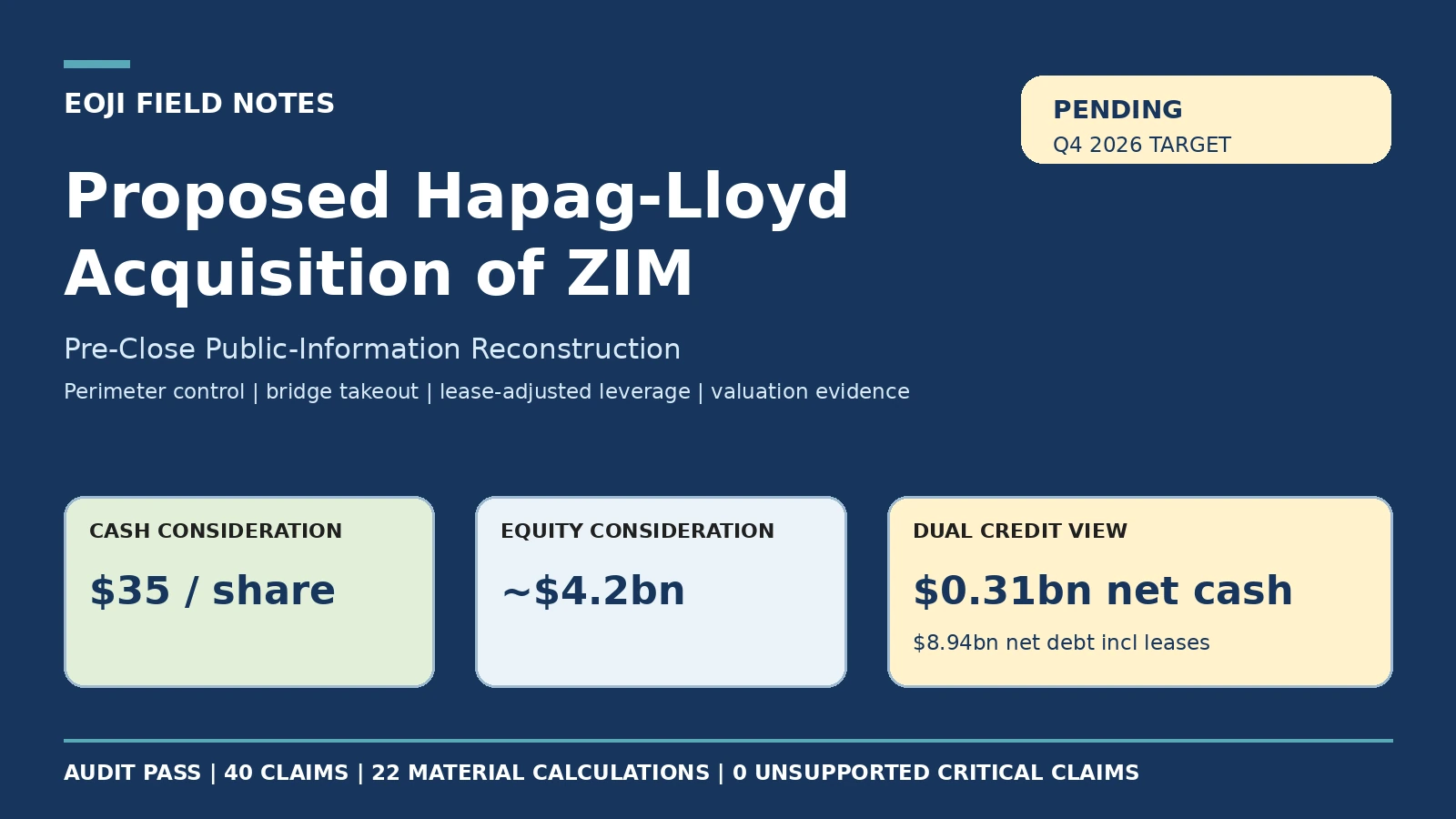
Transaction status as of September 1, 2026: Pending. ZIM shareholders approved the merger on April 30, 2026, while regulatory clearances and approval connected with Israel's Special State Share remain outstanding. The current public target is the fourth quarter of 2026. Hapag-Lloyd and ZIM continue to operate independently.
Executive View
Hapag-Lloyd agreed to pay $35 in cash for each ZIM share. ZIM describes the aggregate consideration as approximately $4.2 billion of equity value. The distinction is critical because public information does not yet support a definitive acquisition enterprise value. Part of ZIM's business is intended to transfer to a FIMI-owned Israeli company, New ZIM, before or in connection with closing. See ZIM's transaction announcement and the SEC proxy statement.
The controlled conclusion is:
EOJI analytical conclusion, not a transaction fact. The $35 offer falls within most signing-date advisor ranges but is not demonstrably cheap. Public sources show a large buyer liquidity reserve and disclosed bridge headroom, while unrestricted post-close liquidity cannot yet be determined. The credit answer changes materially with lease treatment.
| Question | Public answer | Evidence status |
|---|---|---|
| Transaction status | Pending; shareholder-approved; Q4 2026 public target | Reported, forward-looking timing |
| Cash consideration | $35 per share | Reported |
| Aggregate consideration | Approximately $4.2bn of equity value | Reported |
| New ZIM | Separate FIMI-owned Israeli shipping business | Reported structure; final transferred perimeter undisclosed |
| Bridge financing | $2.5bn of disclosed headroom; Bank of America sole underwriter | Reported headroom and underwriter; draw and economics undisclosed |
| Announced synergies | $300m-$500m annual run-rate | Reported target; realization and costs undisclosed |
| EOJI conclusion | Funding headroom is visible, but perimeter, lease treatment, takeout and cycle normalization govern the credit conclusion | Analyst inference |
The Perimeter Problem
The public record contains three New ZIM vessel reference points. The Special State Share requires a minimum fleet of 11 seaworthy vessels. The proxy describes a negotiated FIMI framework involving at least 12 vessels. ZIM's public transaction announcement describes New ZIM as operating 16 vessels.
These are distinct legal, negotiated, and public operating descriptions. They are not a reconciled closing fleet schedule. The reviewed public sources do not allocate cash, conventional debt, lease liabilities, working capital, employees, customer contracts, routes, services, or earnings between the Hapag-acquired business and New ZIM.
That gap changes what may be stated:
| Permitted statement | Prohibited statement |
|---|---|
| Approximately $4.2bn is the announced equity consideration | $4.2bn is the definitive acquisition enterprise value |
| Two perimeter-unadjusted EV screening views can be shown | Either screening view is the final closing EV |
| New ZIM changes the acquired perimeter | New ZIM is immaterial without supporting allocation evidence |
The New ZIM transfer is the only partial test in the frozen-method holdout. It does not prevent publication because the uncertainty is explicit and controls the conclusion.
Why Lease Treatment Changes the Credit Answer
ZIM reported $2.46 billion of net cash when lease liabilities are excluded, but $2.77 billion of net debt when leases are included. The difference reflects a lease-heavy operating model rather than two competing factual accounts. See ZIM's Q2 and H1 2026 results.
| Illustrative target bridge | Excluding leases | Including leases |
|---|---|---|
| Offer equity consideration | $4.20bn | $4.20bn |
| Target net debt / net cash | $(2.46)bn | $2.77bn |
| Illustrative target EV | $1.74bn | $6.97bn |
The same divergence remains after combining the latest public buyer and target balance sheets:
| Simplified pro forma screen | Excluding leases | Including leases |
|---|---|---|
| Net debt / net cash after equity consideration | $(0.31)bn | $8.94bn |
| Net leverage on annualized H1 2026 EBITDA | (0.07)x | 2.13x |
| Net leverage with $400m full run-rate synergy | (0.07)x | 1.95x |
These are screening calculations, not closing, rating, or covenant leverage. They exclude the New ZIM allocation, closing fees, dividends, minimum-liquidity requirements, and accounting alignment. Providing one leverage number would hide the most important credit-definition issue in the transaction.
Funding and Bridge Takeout
Hapag-Lloyd's transaction presentation showed a $7.5 billion liquidity reserve as of September 30, 2025. Its latest H1 2026 financial report shows a €5.185 billion reserve, comprising cash, special funds and unused credit lines. Translated at Hapag-Lloyd's reported June 30 rate of 1.14 USD per euro, that is approximately $5.91 billion, about 21.2% below the signing snapshot. The latest balance sheet therefore governs the current funding screen. See Hapag-Lloyd's H1 2026 report and its transaction presentation.
Hapag-Lloyd disclosed $2.5 billion of bridge-financing headroom. White & Case identifies Bank of America as sole underwriter. The public record does not disclose the actual draw, pricing, maturity, fees, covenants, or final takeout instruments.
| Full bridge draw sensitivity | Annual interest |
|---|---|
| 5.0% | $125.0m |
| 6.5% | $162.5m |
| 8.0% | $200.0m |
At the central 6.5% sensitivity, $162.5 million of annual interest equals approximately 54% of the low $300 million synergy case, 41% of the $400 million midpoint, and 33% of the high $500 million case. These are transparent sensitivities, not contractual financing terms. They also precede integration costs, tax, and delayed realization.
Valuation Evidence
The $35 offer represents approximately a 58% premium to the prior-day close, 90% to the 90-day VWAP, and 126% to the unaffected price identified in the transaction materials. Premiums show the relationship to prior trading prices. They do not establish intrinsic value.
The proxy discloses several signing-date advisor analyses:
| Signing-date method | Range | Position of $35 |
|---|---|---|
| Evercore DCF | $19.27-$40.85 | Within range |
| Evercore 2026E EBITDA comparables | $23.70-$49.84 | Within range |
| Evercore tangible book | $20.00-$30.00 | Above range |
| Barclays 2026E EBITDA comparables | $32.10-$44.01 | Within range |
These are evidence of the board's decision process at signing. They use method-specific assumptions, including management projections, selected multiples, balance-sheet dates, discount rates, and lease conventions. They are not current appraisals and are not averaged into a point value.
Current Earnings and Shipping-Cycle Risk
Hapag-Lloyd reported €1.134 billion of H1 2026 EBITDA, down from €1.759 billion in H1 2025, while maintaining a wide €2.3 billion to €3.2 billion full-year EBITDA outlook. ZIM reported $804 million of H1 adjusted EBITDA and issued full-year adjusted EBITDA guidance of $2.0 billion to $2.4 billion.
The current results and forward-looking ranges must coexist. Strong guidance does not erase weaker year-on-year first-half results, and annualizing six months does not normalize a shipping cycle. Freight rates, vessel supply, fuel costs, geopolitical disruption, route changes, and charter economics can change rapidly.
The deal therefore has four central pre-close falsification tests:
- A final New ZIM transfer schedule must reconcile acquired assets, cash, leases, working capital, contracts, and earnings.
- The bridge or takeout disclosure must establish draw, pricing, maturity, fees, covenants, and refinancing structure.
- A synergy plan must show annual ramp, cost-to-achieve, ownership, baselines, and non-duplicated realized benefits.
- Post-close and through-cycle results must show whether current earnings can support the final debt definition.
Principal Risks
| Risk | Current evidence | Release treatment |
|---|---|---|
| New ZIM perimeter | 11, at least 12, and 16-vessel descriptions; no transferred balance sheet | No definitive closing EV |
| Bridge takeout | $2.5bn headroom and BofA underwriting confirmed; economics absent | Sensitivity only |
| Lease convention | Public debt definitions produce materially different leverage | Show both views |
| Shipping cycle | H1 earnings declined year on year while full-year outlooks remain wide | No spot-year capitalization |
| Synergy execution | $300m-$500m run-rate target; no phasing or integration cost | No immediate full credit |
| Regulatory timing | Shareholder approval obtained; Golden Share and other approvals remain | Pending, no closing probability |
Audit Result
The unchanged BASF-style audit inventories 40 material claims, identifies 31 critical claims, independently reperforms 22 material calculations, discloses six analytical assumptions, reviews ten apparent contradictions, and registers nine publication sources.
| Release control | Result |
|---|---|
| Unsupported critical claims | 0 |
| Claim failures | 0 |
| Calculation failures | 0 |
| Method changes after holdout opening | 0 |
| New ZIM perimeter | Open and explicitly controlled |
| Bridge economics | Open and sensitized |
| Release verdict | Approved as a pre-close public-information Field Note |
The contradiction review specifically separates equity value from transaction-value wording, reconciles stale and current liquidity dates, preserves both lease definitions, distinguishes bridge headroom from actual draw, and keeps signing-date valuation ranges separate from current results.
Pre-Close Versioning Control
This page is a record of information available through September 1, 2026. An official approval, financing, closing, termination, or material New ZIM perimeter update should create a dated successor version. It should not silently overwrite what could reasonably be concluded before the outcome was known.
This Field Note and its supporting materials are independent public-information analysis. EOJI is not affiliated with Hapag-Lloyd, ZIM, FIMI, Bank of America, or their advisers. The materials are not a closing statement, fairness opinion, credit rating, financing commitment, investment recommendation, lending decision, completion forecast, or representation of confidential transaction economics. They do not constitute investment, credit, legal, regulatory, tax, accounting, or risk-management advice.
Discuss a source-linked transaction analysis workflow
EOJI structures public evidence, valuation assumptions, downside cases, and diligence questions into reviewable transaction work.
Discuss a transaction workflow